
Every pot you make is shaped by two firings: the one that turns soft clay into durable ceramic, and the one that melts glass onto its surface. Between them sits a language of cones, ramps and holds that can look intimidating from the outside. It needn't be. Once you know what the heat is doing to the clay at each stage, choosing a temperature stops being guesswork and becomes a decision you can repeat, adjust and eventually trust.
The awkward part is that a kiln never simply gets "hot". It travels through a series of thresholds, and each one asks something different of your work. A schedule that flatters a thin porcelain bowl can ruin a chunky sculpture, not because the final temperature is wrong but because the journey there was too fast for the thickness of the clay.
What Heat Actually Does to Clay
A kiln is not an oven with a dial. It is a series of chemical changes, and each one happens in a particular band of temperature. Race through any of them and the pot tells you about it later, usually with a crack or a bloated surface.
- Up to about 100°C — free water leaves the clay. This is the stage that explodes pots if you rush it, because trapped steam has nowhere to go.
- 350–600°C — carbon and organic matter burn away, and the chemically combined water inside the clay's structure is driven off.
- Around 573°C — quartz inversion. The silica in the clay changes crystal structure and moves quickly. Most schedules slow down between 500°C and 600°C for this reason alone.
- 900°C and above — sintering begins. Particles fuse at their edges, the body shrinks, and porosity drops. Push further and you head towards vitrification, where the clay becomes dense and glassy.
Those four bands explain most firing advice you will ever read, including why bisque firings are slow and why nobody sensible opens a hot kiln.
Why the Middle of the Firing Is the Dangerous Part
Beginners tend to worry about the top of the firing, when the kiln is glowing and the elements are working hardest. In practice, most damage happens much earlier. A mug with a thick, damp base loaded on a wet afternoon may look perfectly dry, yet a fast climb through the water-smoking stage will trap steam inside that base and blow a chunk out of it somewhere around 300°C.
This is why experienced potters "candle" the kiln — holding it at a low temperature, often between 80°C and 120°C, with the lid or bung slightly open, until every trace of moisture has drifted away. It costs an hour and saves a shelf of work.
Cones: The Potter's Thermometer
A pyrometric cone is a small pyramid of ceramic material that softens and bends when it has absorbed a specific amount of heat. That phrase matters. Cones measure heat work: the combination of how hot the kiln got and how long it stayed there. A kiln that reaches 1200°C and holds for forty minutes has done more to a glaze than one that brushes the same temperature and falls straight back down. Your controller measures temperature; a cone measures what the clay and glaze actually received.
Two things confuse newcomers about cones. The first is the numbering. Cone 06 is not hotter than cone 6 — the leading zero signals a lower temperature, so cone 04 sits around 1060°C while cone 4 is closer to 1180°C. The second is placement. A cone in the middle of the stack may bend long before one tucked into a cold corner near the door, and that difference is genuine information about your kiln, not a fault in the cones.
Most studios fire with at least three: a guide cone one number cooler, a target cone, and a guard cone one number hotter. If the target bends and the guard stays upright, the firing landed where you wanted it.
Fire slowly, cool slowly, and let the cone decide when the work is done — not the clock, and not the controller.
Bisque Firing: Making the Pot Strong Enough to Handle
Bisque firing does two jobs. It hardens the raw clay so you can glaze it without it dissolving in your hand, and it burns out the organic material that would otherwise bubble through your glaze. Most potters bisque between cone 06 and cone 04, roughly 1000°C to 1060°C.
There is a real argument for staying on the cooler end. A low bisque leaves the body porous, which means glaze soaks in and grips well. Fire bisque too hot and the clay begins to vitrify, closing its surface so thoroughly that glaze sits on top like paint on glass and later flakes away. The exception is sculptural work, where a hotter bisque gives strength that the piece needs before it is handled again.
A typical bisque schedule heats slowly to 120°C, holds to drive off moisture, then climbs at around 100–150°C per hour, slowing deliberately through quartz inversion, before a short hold at the top.
Glaze Firing: Where the Surface Comes Alive
The glaze firing takes the bisqued pot up to the temperature at which your particular glaze recipe melts. Get this wrong in either direction and the result is obvious: underfired glaze stays dry, matte and rough; overfired glaze runs off the pot and fuses it to the shelf.
Glazes are grouped by the temperature they are formulated for, and clay bodies are grouped the same way. The two must match.
- Low fire, cone 06–04 (about 1000–1060°C) — earthenware, bright commercial colours, glossy surfaces. Forgiving for beginners, but the body stays porous and needs a well-fitted glaze to avoid crazing.
- Mid fire, cone 5–6 (about 1180–1220°C) — the workhorse range for electric kilns. Strong, vitrified stoneware with a wide palette of reliable glazes.
- High fire, cone 9–10 (about 1260–1300°C) — reduction or wood firing, dense porcelain and stoneware, and the subtle, shifting surfaces that draw many potters to the craft in the first place.
Mismatch the two and you get dunting: the glaze contracts more than the clay on cooling, and fine cracks spread across the surface, sometimes months after the pot leaves the studio.
Ramps, Holds and Cooling: Reading a Firing Schedule
A schedule is simply a list of segments, each with a target temperature and a rate of climb. Two additional controls do most of the fine-tuning.
- Holds — a pause at the top temperature, often ten to thirty minutes, to let glazes smooth out and heal pinholes without pushing the clay any hotter.
- Controlled cooling — slowing the drop through the 1100–900°C range, which encourages crystal growth and can turn a plain glaze into something with depth and movement.
Cooling too fast does its own damage. Thin rims and wide flat plates are especially prone to thermal shock, and a kiln cracked open at 400°C can produce the sharp ping of a pot that survived the fire only to fail on the way down.
When Things Go Wrong: Reading the Signs
Firing faults are rarely mysterious once you know what to look for.
- Cracked or exploded bisque — moisture, almost every time. Candle longer and slow the early climb.
- Blistered glaze — often overfiring, or a glaze applied too thickly, or bisque fired so hot that trapped gases had nowhere to escape.
- Pinholes — gas breaking through a glaze that sealed over too early. A longer hold at the top usually solves it.
- Crazing — a glaze fit problem, not a temperature problem. Adjust the recipe or change the clay body.
- Dry, lifeless surface — underfired. Check that your cones actually bent before you blame the glaze.
Getting to Know Your Kiln
Every kiln has its own personality: a hot spot near the elements, a cool corner by the door, a thermocouple that reads a little optimistically. The only way to learn it is to fire consistently, note what you did, and keep the cones. After a dozen firings you will stop treating the schedule as a rule and start treating it as a conversation.
That is the real shift. Bisque and glaze firing are not two boxes to tick before a pot is finished. They are the stages where clay becomes ceramic, and where a careful record of cones, ramps and holds turns a lucky result into a repeatable one.
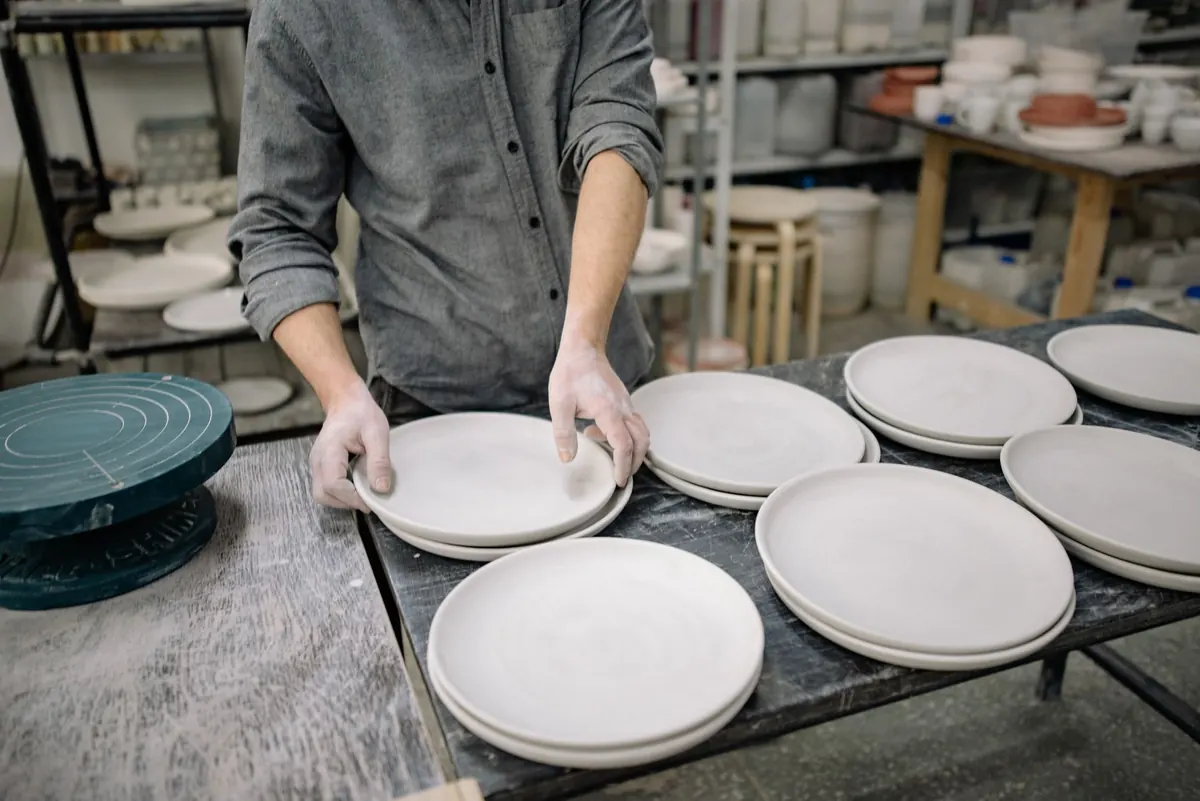
Photo: Yan Krukau / Pexels